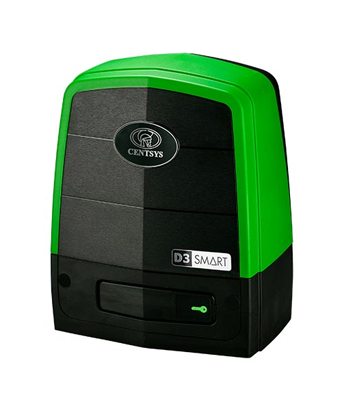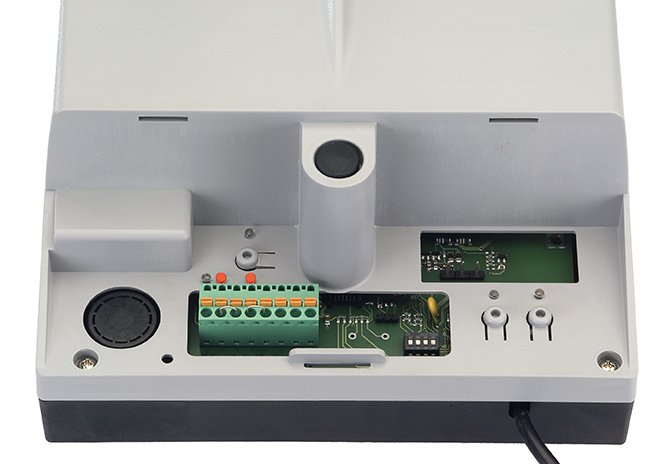
E700 HS
Electronic control unit
Use application field For 24V garage and sectional door automations- The E700HS board can be used on the D700 HS operator for sectional doors.
- OMNIdec technology allows the integarted remote controls decoding.
Dimensions and technical specifications
| Model | E700 HS |
|---|---|
| Power supply voltage | 220-240V~ 50/60 Hz |
| Max. accessories load | 200 mA |
| Accessories power supply | 24V |
| Operating logic | Automatic, Semiautomatic |
| Courtesy light timing | 2 min |
| Thrust power | Automatic |
| Terminal board inputs | Open, Stop, Safety devices, Failsafe, Flashing light 24V |
| Rapid connector | for receiver control units XF 433/XF 868, Battery module |
| Operating ambient temperature | -20°C ÷ +55°C |
Add To Cart
Frequently Asked Questions
"HS" stands for High Speed, indicating that the FAAC E700 HS is specifically engineered to control high-speed gate motor applications. This makes it the appropriate control unit for installations where rapid gate opening and closing cycles are required — such as high-traffic commercial entrances, security checkpoints, or industrial sites where minimising vehicle wait times is a priority.
The E700 HS is designed for commercial and industrial sliding gate applications where speed and reliability are critical. It is commonly used at busy logistics facilities, car parks, industrial compounds, and secure commercial premises where the gate needs to cycle quickly and frequently without compromising on safety or motor longevity.
Despite the increased operating speed, the E700 HS supports the full range of FAAC safety accessories, including photocells, safety edges, and loop detectors. The control unit processes safety inputs rapidly to ensure the gate can stop quickly if an obstacle is detected, maintaining compliance with safety requirements even at elevated operating speeds.
Yes. The E700 HS is designed to work with encoder-equipped motors, using positional feedback to manage the gate's acceleration and deceleration profiles precisely. This is particularly important at high speeds, where accurate deceleration before the end of travel is critical to prevent mechanical shock and premature wear on the gate and motor components.
High-speed operation places greater demands on the gate's mechanical components — particularly the rack, pinion, guide wheels, and end stops. Regular inspection and lubrication of these components are more important than in standard-speed installations. We recommend a more frequent service schedule for high-speed systems to ensure continued safe and reliable operation.